

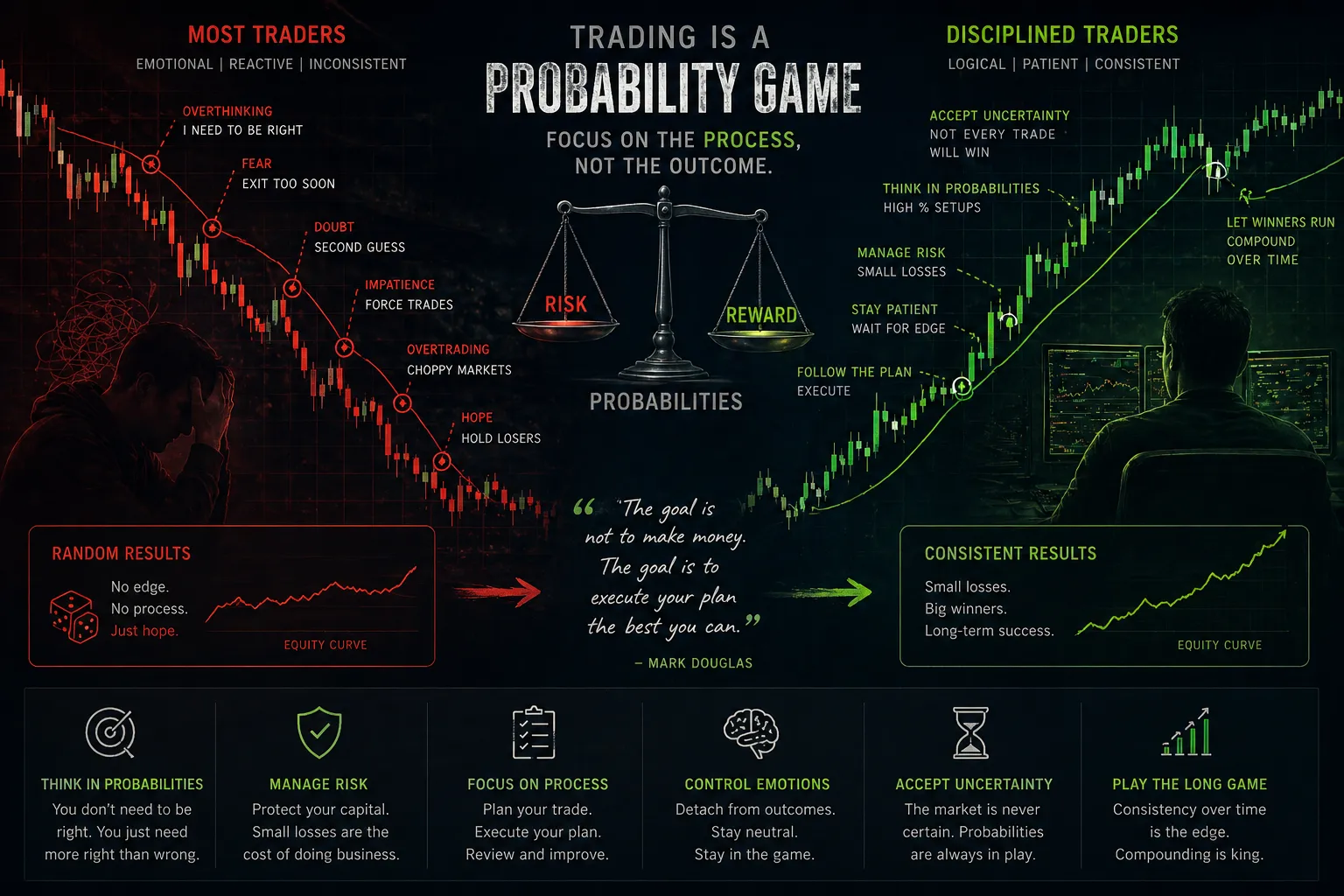
Trading is not about being right every time — it is about thinking in probabilities.

One trade does not define your edge; a series of trades reveals it.

Emotional neutrality helps you execute without fear, hesitation, or revenge.

The Insight
Most traders treat each trade like a personal test. Mark Douglas taught the opposite: trading is a probability game. Any single trade can win or lose, but that outcome does not define whether your process is good.

What This Means
This means you do not need certainty to trade well. You need a defined edge, a clear risk, and the discipline to execute repeatedly without attaching your identity to one result. The market is not rewarding or punishing you — it is simply producing outcomes.

What Good Traders Do Differently
Good traders separate process from outcome. They can take a losing trade without calling themselves wrong, and they can take a winning trade without assuming they are invincible. They judge themselves by execution, not by one random result.

How to Apply This
Before entering, define your setup, risk, and execution rules. Then judge the trade by whether you followed the plan, not by whether it won. Track results over a meaningful sample size instead of reacting emotionally to one trade.

The Real Lesson
The real lesson is that consistency is mental before it is technical. When you accept uncertainty, you stop needing every trade to work. That is when you can execute clearly, stay objective, and let your edge play out over time.
When you really believe that trading is simply a probability game, concepts like right or wrong or win or lose no longer have the same significance.— Mark Douglas