

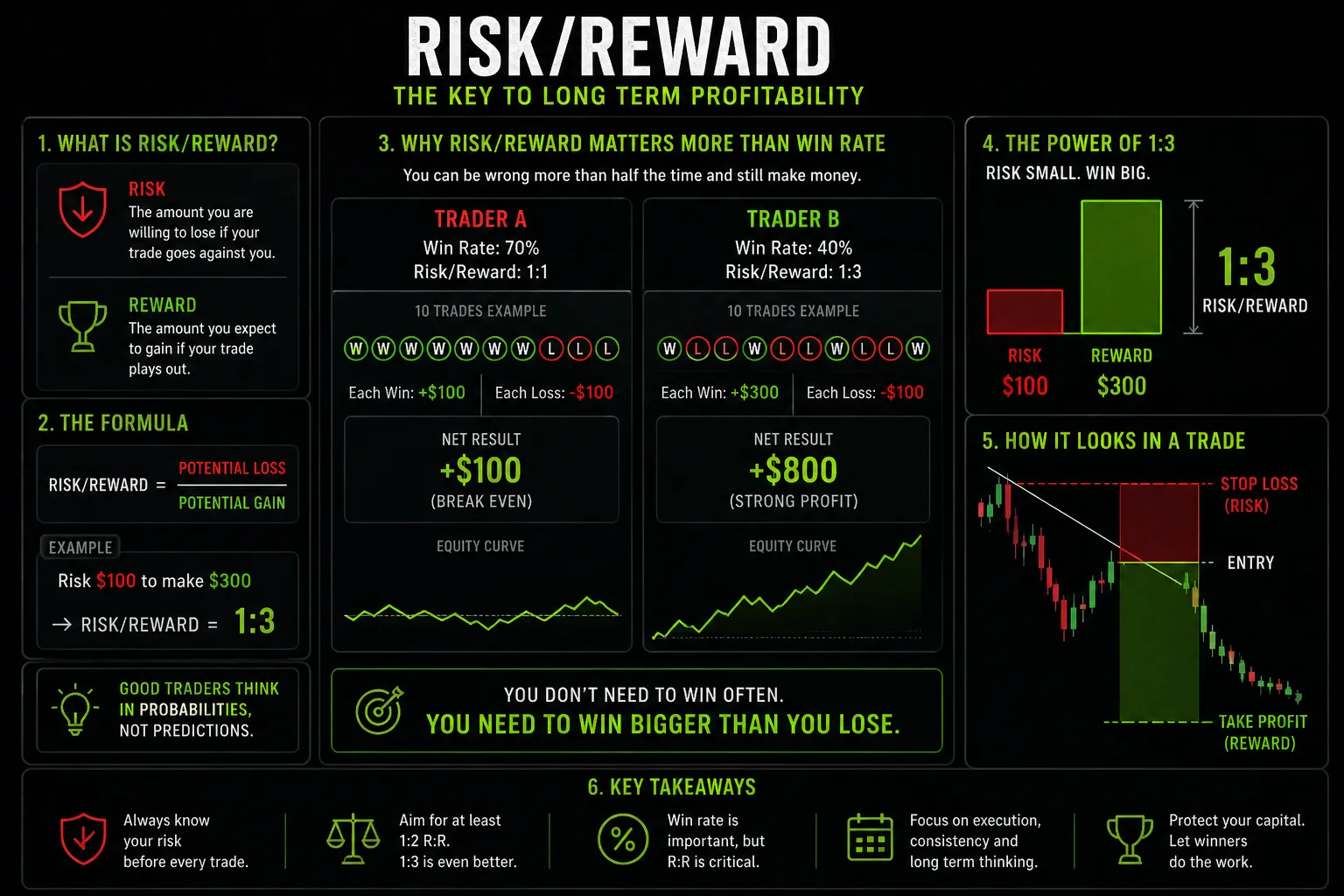
Risk is what you are willing to lose; reward is what the trade can realistically pay you.

A lower win rate can still be profitable when your winners are large enough.

Good traders define the stop, target, and risk/reward before they enter.

The Insight
Most beginners think profitable trading means being right most of the time. The real edge is not accuracy alone — it is the relationship between what you risk and what you can make. A trader can be wrong more than half the time and still make money if the winners are large enough compared to the losses.

What This Means
Risk/reward forces you to ask the question most traders avoid: is this trade actually worth taking? Risk is the amount you are willing to lose if the idea fails. Reward is what you stand to gain if the idea works. If you are risking too much to make too little, even a decent win rate can still leave you struggling.

What Good Traders Do Differently
Good traders think in probabilities, not predictions. They do not enter first and figure out risk later. They define the entry, stop-loss, target, and risk/reward before the trade. They are willing to skip mediocre setups because one good 1:3 trade can do more for the account than several low-quality 1:1 guesses.

How to Apply This
Before entering, identify your stop-loss first. Then identify the realistic target based on structure, support, resistance, or measured levels. Use the position tool to check whether the potential reward justifies the risk. If the setup cannot offer at least a clean 1:2 — and ideally 1:3 or better — it may not be worth forcing.

The Real Lesson
The real lesson is that trading is not about being right all the time. It is about building a system where the math works over many trades. A high win rate with poor risk/reward can still produce weak results, while a lower win rate with strong risk/reward can be profitable if the trader stays disciplined.

You don’t need to be right all the time — you need to be right efficiently.— Risk/Reward Trading Principle