

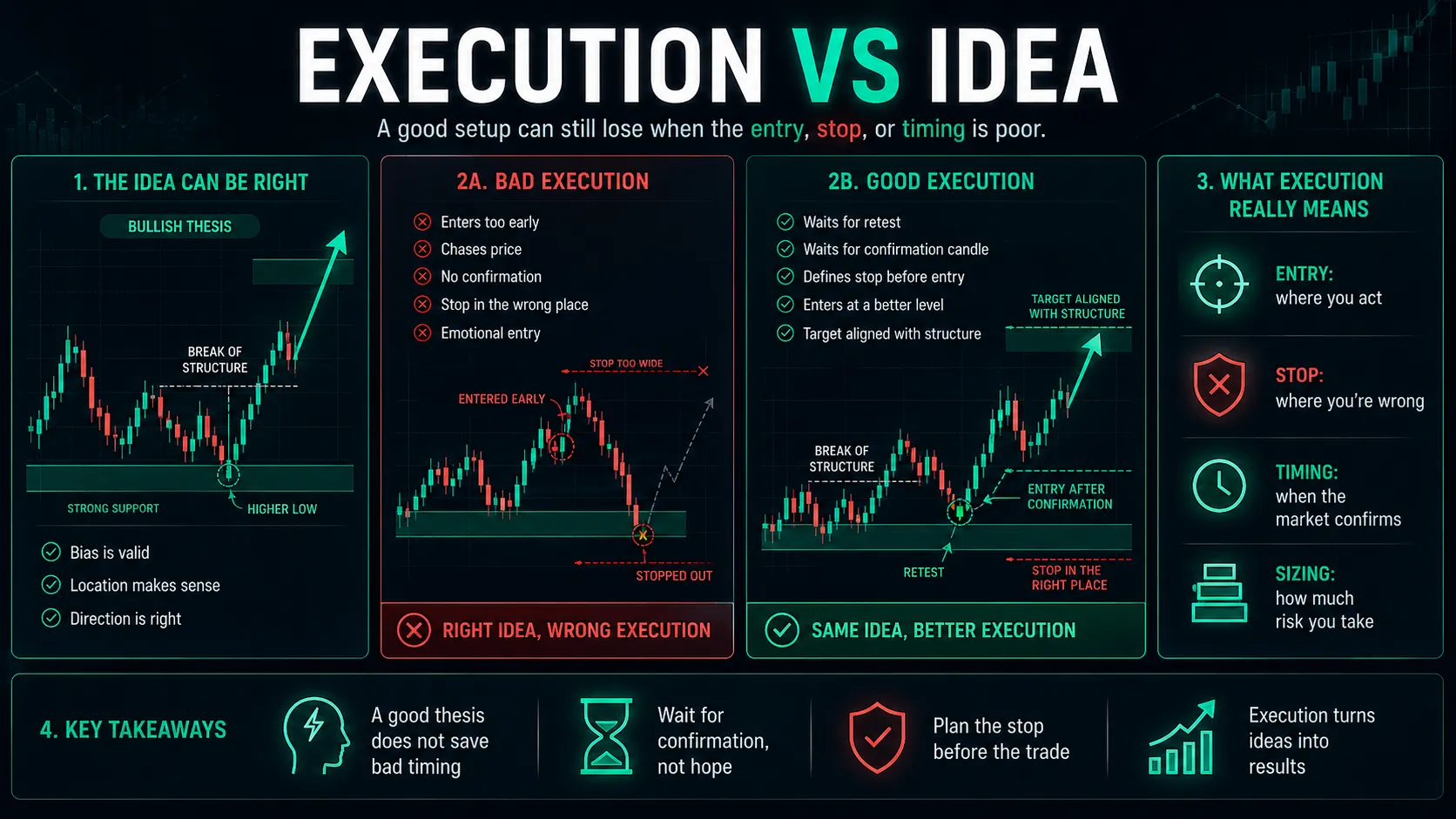
A losing trade does not automatically mean the idea was wrong.

Separate idea quality from execution quality during trade review.

Bad entries, tight stops, poor management, and oversized positions can ruin good ideas.

The Insight
A trade has two separate parts: the idea and the execution. The idea is the thesis: price reaches a level and you expect a reaction. The execution is how you actually trade it: entry, stop placement, size, management, and exit. A losing result does not automatically tell you which part failed.

What This Means
If price never reacts from your level, the trade idea was probably wrong. That means the review should focus on analysis: missed higher time frame structure, wrong time of day, bad location, or fighting the intraday trend. But if price does react from the level and you still lose, the issue may be execution.

What Good Traders Do Differently
Good traders do not review every loss the same way. They ask a better question: was the idea wrong, or did I execute it poorly? If the idea was wrong, they refine their analysis. If the idea was right but they got shaken out, entered too early, used too much size, or placed the stop too tight, they refine execution.

How to Apply This
After each trade, label it in two categories. First: was the trade idea correct? Did price do what you expected from the area you were watching? Second: was the execution clean? Review entry timing, stop placement, trade management, position size, and whether the trade followed the plan. Over time, repeated labels reveal your actual weak point.

The Real Lesson
Good idea, bad execution is still a losing trade. But if you review everything as simply “win” or “loss,” you never learn what actually needs to improve. The trader who separates idea from execution can fix the right problem instead of randomly changing the whole system.
A good idea can still lose if the execution is bad.— Trading Insight